This is and isn’t working, which I suppose is the least shocking sentence ever written by a person attempting to make anything grow.
Failure is part of the journey, not in the inspirational mug way, not in the “everything happens for a reason” way, which always makes me want to throw the mug, but in the dirt-under-your-fingernails way; in the humiliating, expensive, slightly absurd way; in the way first attempts are often just practice rounds for the thing you meant to build in the first place.
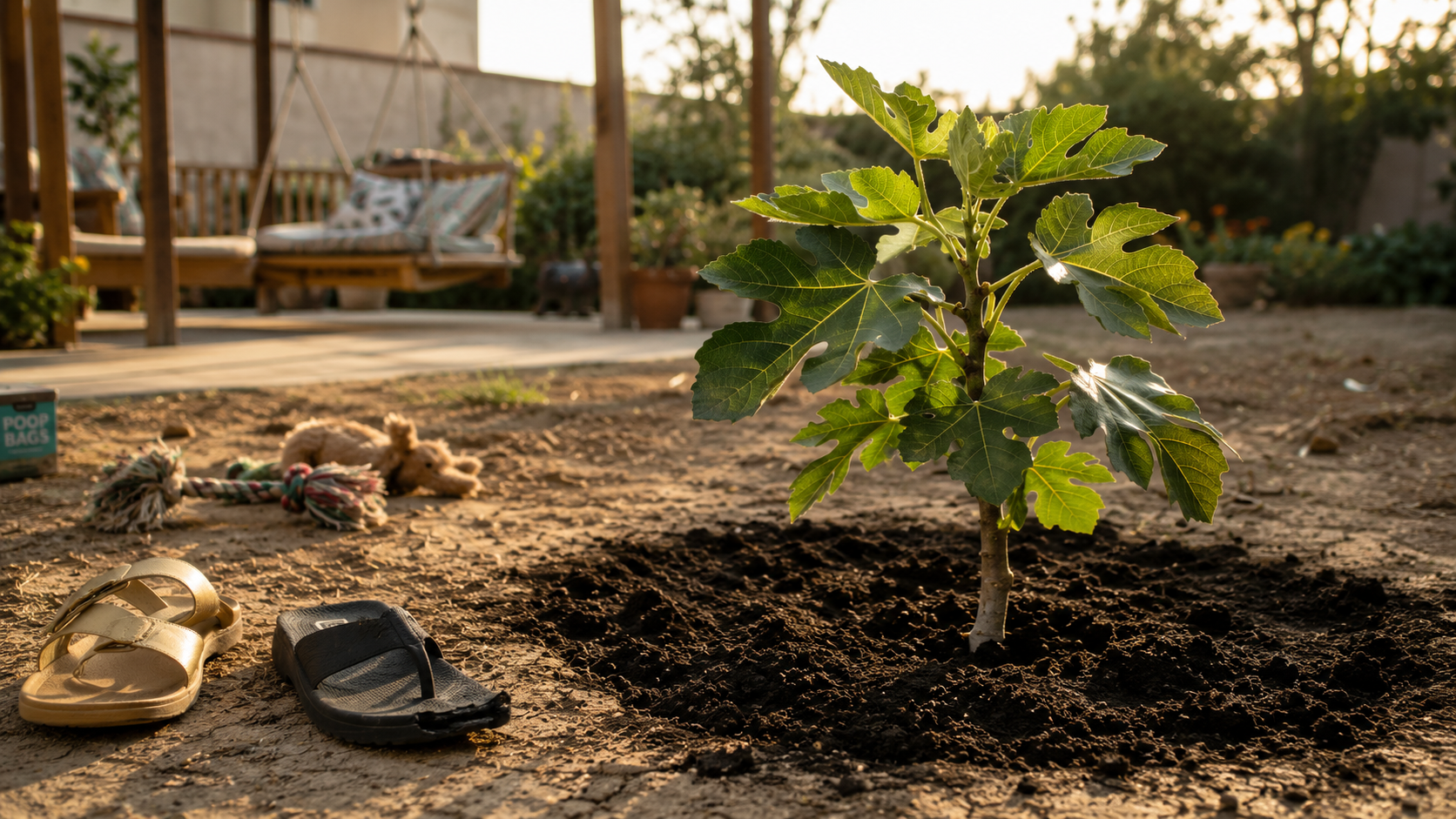
I’m reminded of this as I stand in my backyard stroking the leaves of my young fig tree, rubbing them between my fingers and assessing their sandpapery quality, which feels right. The leaves are deep green and sturdy, giving off an air of hearty little defiance, and this one, I think, is taking. At seven feet tall, she is a giant compared to my first attempt at building a backyard nursery, which was less nursery and more crime scene.
The ground then was dry and clay-caked and ugly, and the holes were dug by a gardener named Humberto, who claimed he had an amazing team. When the trees arrived from the online company boasting unmatched root ball maturity, I was convinced what would be delivered would look, at least loosely, like trees, but instead, three twigs with gnarled heads and one tiny bushel labeled “fig tree” waited for me in a pile of boxes so small I thought they were my Amazon Subscribe & Save delivery.
But no, they were my trees, and Humberto’s team was scheduled to plant them the next day, which meant I could only imagine the conversation as they dug the holes and staked those sad little sticks upright, pretending there was any reasonable chance they’d grow into something.
Maybe it was my husband’s utter dismay at having taken these atrocities seriously, or maybe it was my own shielded disappointment sending bad vibes their way, because this is Southern California and, yes, we take vibe things seriously; or maybe it was simply the crumbled gray clay, dead in a way even worms wanted no part of. Whatever the cause, the trees shriveled up and died almost immediately.
This seven-foot beast was our third attempt at planting a fig tree, and by the time she went into the ground, the hole was black and soft and alive, easy enough for me to finish digging myself, full of tiny worms and burrowing roly-polies doing their little underground union jobs. Almost immediately, she sprouted new leaves, which felt like a good omen, or at least like the universe had finally stopped being petty about my landscaping ambitions.
I learned later that all it takes is a fifty-dollar tree.
It’s the hole that requires the investment.
As I walk from the fig to check the other trees, I watch my feet, because my flip-flops are mismatched but the same brand, so emotionally it feels legal. A gold double-strapped Reef on the left and a black thick-pleated one on the right have become, through necessity and dog-related destruction, a natural pair, and since my dogs eat shoes like daily supplements, I’ve stopped buying new ones until I’ve exhausted every possible combination. Unless someone decides to have an entire conversation with my feet, it’s not going to be a point of contention.
What is a point of contention is the dog shit, which I really need to pick up.
The day is luxuriously free. Derek is golfing, and before I set myself to the task of gloving up in dog poop bags stamped with “give a shit,” because apparently even feces removal needs branding, I pair the new JBLs that arrived that morning in a box that could also have contained a tree. Noah Kahan is queued, “Call Your Mom” starts playing, soothing me like morphine for the overly verbal and under-medicated, and after texting my friend that I’m ready whenever she is, I head outside with my poop bags and my soundtrack.
Dog shit duty is less grueling when I’m otherwise happy, or at least when I’m trying to be.
The call, I hope, will be business-centric, since my last text to her had been a proposal of sorts, carefully fleshed out into specifics with the help of ChatGPT, because apparently robots are now my unpaid emotional support interns. I’d asked if she’d consider tagging in on my novels, helping turn them into something real and packaged and ready, and because we’ve spent years collaborating and writing and watching each other evolve in different directions, I had hoped she’d be excited. I thought maybe we had both grown into our own strongholds, and from those places, maybe we could build something together.
In hindsight, I may have been dramatic, which is always a shocking development.
Our conversation never really goes there, though. Instead, we do what we usually do: life things, health things, marriage things, the “how are you holding up?” things, the “are you going to leave him?” things, the “life isn’t supposed to be this way” things, which should probably be printed on bumper stickers at this point.
I don’t know how to explain my life to people who haven’t lived inside it, though I try. I say, “Unless you’ve lived in someone’s reality, you can’t judge their tolerance for things,” and I say, “I’m okay,” and I say, “It’s complicated,” and all of those things are true, but none of them are the whole truth. The whole truth is too large to hand someone over the phone while I’m standing in my backyard holding a bag of fossilized dog shit.
Eventually, mercifully, we drift to my writing, and my ears perk up like the new fig leaves because maybe, I think, this is the moment where we move toward something hopeful.
I sit on the swing beneath the pergola, protected from the sharp overhead sun, while the ropes creak against their hooks in a way that reminds me, constantly, that at any moment this too could drop out from under me. I know the limits of the machinery, and I know the weak points, and in reality, the only true failure point is the pergola itself, which, in a wind-and-salt-soaked city, is not nothing.
“I think you should write new books and stop editing your series,” she says, plainly, like she’s telling me the milk has gone bad.
I stop talking, and she fills the silence.
“I’ve become intolerant of poor writing,” she says. “Exposure to all these great novels has really ruined that for me.”
Well.
There it was, the thing I had been afraid of, wrapped neatly and handed over without a bow.
I do what women do when they’ve been hit but don’t want to bleed on the furniture: I pivot. I bring up The Paper Palace, and I talk about something brilliant and devastating and gorgeous, something I aspire to create one day, something safe to admire because it is not mine.
We spend more time dissecting the nuance of that writing, the complexity of the sentences, the way dark subject matter can be held with grace instead of melodrama, and the bravery and skill it takes to craft something magnificent. And in the recesses of my mind, where all the worst goblins live, I wonder if she is bringing this up because she doesn’t believe I’m capable of it.
That kind of thought can ruin a person, because fear of failure is an affliction right up until the exact moment success becomes real.
When the call ends, I feel deflated, and maybe I am, and forever will be, a hack; who knows? I won’t really know until readers pick the thing up and read it, which, consequently, is actually happening.
So I check my Facebook messages and reread Grace’s last note to me, where she praises my prose and says things like, “Your sentences are powerful” and “I’m impressed by the strength of your writing,” and I remember something important.
Grace has the version of the novel that exists now.
My friend read the version that came out of me in one wild, messy burst a year and a half ago, the first version, the twig version, the thing with the gnarled head and the audacity to call itself a tree.
First drafts are for trusted friends, and beta reads are for the larger community, and somewhere in the vulnerable disaster of wanting to be understood, I forgot to clarify that. I thought she knew the version she read was the thing that immediately left my hands, still smoking from impact, and I only stayed with the material because, back then, she believed in me. But I had forgotten that with editor-friend passes, you usually get one shot, because they do not always carry you through every revision, every season, every replanting.
That is the nature of energy.
That is the nature of growth.
I had to dig the hole first, and the ground was dead, and the pages were messy, and the roots had nowhere to go, but the potential was there. I believed in it.
So yes, I pulled the first dead thing out of the ground and planted again, and then my dogs ate the second one, because apparently destruction is their love language, and I dug that one out too. Then I planted a third tree, and now the leaves are maturing, small fruit is forming, and though it is still the first season, I believe, in due time, this thing will become a monstrosity.
Not because the first tree lived, but because I kept learning how to make the ground ready.
That’s enough.
Leave a Reply