This morning, I walked out the door for work and my husband called me back.
I was already late. It is offensively humid in Southern California, I shouldn’t even be working on a Friday, and I am tired because tired has somehow become my default setting.
I had made it outside when I heard him.
“Hey. Come back here.”
I went back inside.
He looked at me with that particular seriousness men sometimes summon immediately before saying something either profound or completely ridiculous.
“It’s September 11th. Never forget.”
Then, after a beat:
“That’s why I went. To go get those motherfuckers.”
I laughed.
Because of course that is how he would say it.
No poetry. No sweeping meditation on patriotism or sacrifice. Just the beautifully uncomplicated logic of the seventeen-year-old boy he once was: somebody attacked us, so somebody had to go get the motherfuckers.
And he was going to be one of them.
I kissed him goodbye and left for work.
But I thought about that boy all morning.
I thought about the girl I was then, too.
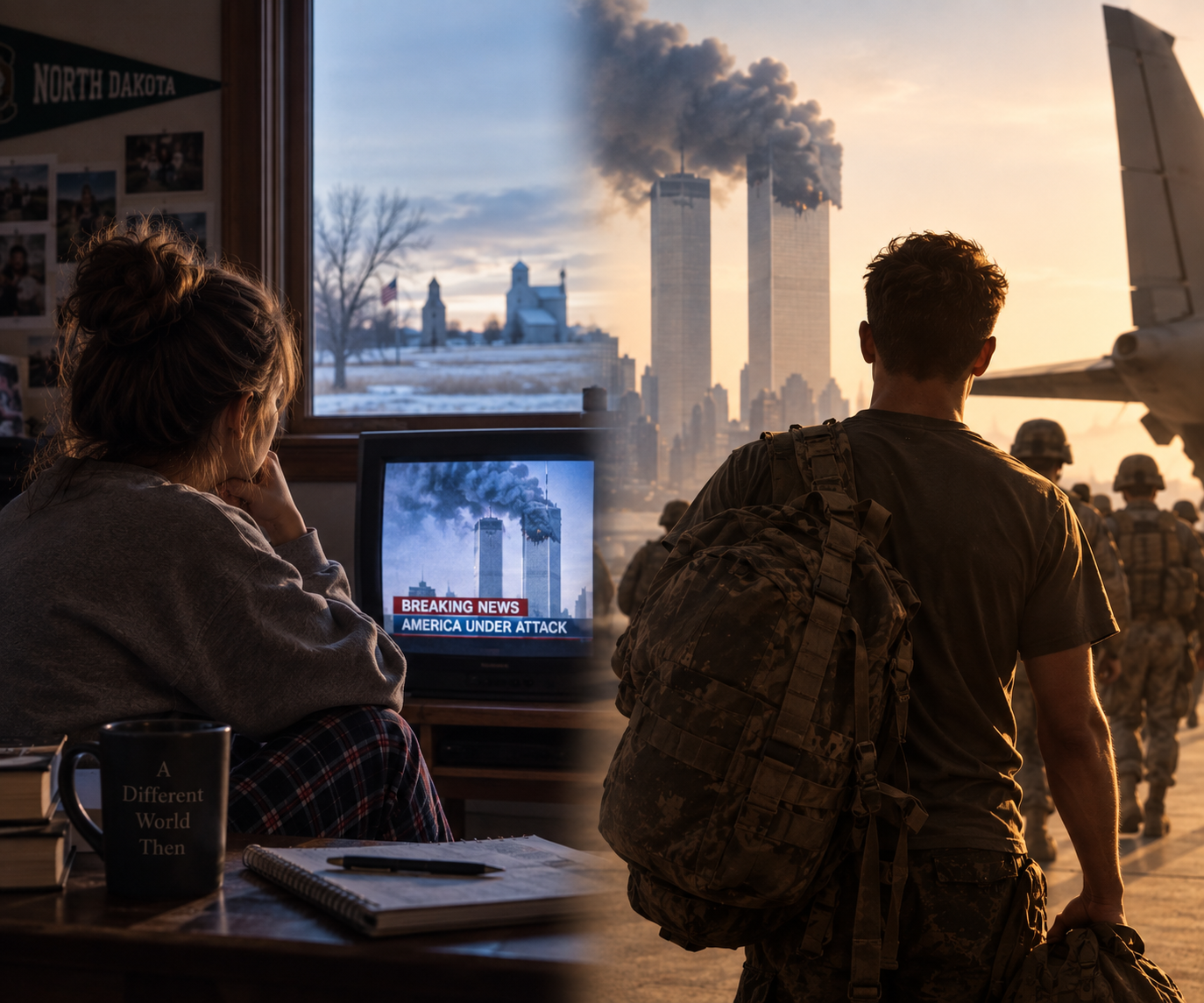
I was twenty years old on September 11, 2001, living in North Dakota. I remember the immensity of that day, the strange understanding that something had happened that divided time itself into before and after. It was my first real encounter, in my fully formed years, with war and terror—with the realization that history wasn’t something safely contained in textbooks, that terrible things did not happen only somewhere else or long ago.
But war was still abstract to me.
I wasn’t surrounded by military men. I didn’t grow up inside military culture. War existed in news programs and newspaper headlines, photographs and grainy television footage. I watched brave young men and women hug their families goodbye and board planes for places I knew mostly from maps.
I understood enough to know they were courageous.
I had absolutely no understanding of what we were asking them to carry home.
How could I?
War was something happening over there.
Fifteen years later, I met the man who would become my husband.
I learned that he had been a Marine, and for a surprisingly long time, that was almost the extent of what I knew.
We barely talked about his service. There were fragments here and there, stories without much context, references I didn’t entirely understand. I knew he had served. I knew he had seen things. I didn’t push, and he didn’t volunteer much.
So I still didn’t really know.
For four more years, I didn’t know.
And then it all came crashing down.
Suddenly the things that had seemed disconnected began revealing themselves as pieces of the same story—the sleeplessness, the hypervigilance, the anger, the memories, the drinking, the moments when the man I knew seemed to disappear somewhere I could not follow.
War stopped being abstract.
It walked into my house.
And in one form or another, this has been my war ever since.
Not a war for a country, not one fought in uniform or on foreign soil, and I would never pretend that what I have endured is equivalent to what he did.
Mine is smaller than that.
One house. One marriage. One man.
A war to save someone who once went to war for all of us.
There was a woman I used to be who would not understand the woman I am now.
I think about her sometimes.
She was certain about things—what she would tolerate, where the lines were, when strength meant staying and when it meant walking away. She believed love should never require this much translation, and that there were circumstances in which the right answer would simply be obvious.
She would look at my life now and tell me I am wrong.
I know she would.
Sometimes I miss the luxury of being her, because there are things you can believe absolutely only before life asks you to prove them.
I am married to a combat veteran with severe PTSD.
There have been nights when I have sat alone trying to figure out what to do next, calling crisis lines and veterans’ resources and numbers that lead to other numbers until eventually the whole system seems to fold back onto itself, while the crisis continues ten feet away and I remain exactly where I started: standing in my own house, trying to decide what happens next.
That is the part I could never have understood before—the extraordinary loneliness of loving someone whose war followed him home.
There are fights that make no sense, accusations about things that never happened, hours spent trying to reason my way through something that has no relationship to reason. Sometimes the person standing in front of me looks like my husband and sounds like my husband, but I cannot find him anywhere inside the room.
Then, sometimes hours later, he comes back.
There he is.
My husband.
That may be the most devastating part of all, because I remember him. I always remember him.
Over time, PTSD has tangled itself around addiction and serious physical illness, memory and sleep, our marriage and the ordinary architecture of our lives, until there are days when I feel less like a wife than someone simultaneously caring for an Alzheimer’s patient, an addict, and a critically ill man—except this patient can resent the caretaker, blame her, criticize her, sometimes hurt her, and still she is the one making the next phone call.
There is no parade for this part.
No one sees the hospital rooms, the vigilance, the negotiations, or the strange calculation you learn to make almost unconsciously about whether tonight is merely bad or dangerous bad. There is no ceremony for becoming fluent in another person’s instability, no recognition for the spouse who stays awake and learns to sleep lightly, who quietly rearranges her life around disasters other people never see.
It is exhausting and frightening and, if I am allowed to say the least noble part aloud, often profoundly thankless work.
People ask why I stay. Some ask gently; some don’t ask at all, because they have already decided what the answer says about me.
I understand them.
The woman I used to be would probably be standing among them.
She would tell me military service does not excuse hurting someone you love, that PTSD does not make abuse acceptable, that I cannot save another human being by allowing myself to be destroyed.
And she would be right.
What she would not understand yet is that sometimes two things can be completely true at the same time: I can love him and say you cannot do this to me; understand where something comes from without accepting where it lands; believe he deserves compassion without surrendering my own safety; refuse to abandon him without agreeing to abandon myself.
It has taken me years to learn how to hold those truths in the same hands.
Because beneath the illness and addiction and damage, beneath everything that has happened between us, I can still see the boy who wanted to go get those motherfuckers.
Except he isn’t seventeen anymore.
And I know what that boy couldn’t possibly have known then.
When his country asked something almost unimaginable of very young men, my husband went. He stood in places most of us would never willingly stand, accepted responsibility for people he had never met, did things few people could do and fewer still would volunteer to do—and then, like so many others, came home carrying things no one could see.
The war ended.
Somehow, it also didn’t.
I have come to think that loving a combat veteran with PTSD sometimes means living closest to the blast radius of a war everyone else believes is over.
I grieve what that war has done to him, what it has done to us, and what it has changed in me. There is a before and an after in my own life now, an invisible border I crossed without realizing it until I looked backward one day and discovered the woman standing on the other side had become almost impossibly far away.
She would not recognize me.
Some days, I barely recognize her.
But I don’t think I am weaker than she was.
I think I know something she didn’t.
Love is not always soft. Sometimes it is a boundary or an emergency room, refusing to participate in someone’s destruction, saying no and meaning it; sometimes it is staying, and sometimes—if staying requires you to surrender yourself completely—it may mean leaving.
I no longer believe devotion is measured simply by endurance, but I also no longer believe every form of staying is weakness.
That is the part I could never have explained to my former self.
I know how he got here.
That does not absolve him of what happens here.
But it matters to me.
It matters enormously.
Once, he accepted an extraordinary responsibility for people he had never met. Now he is struggling to find his way home from what that responsibility did to him, and perhaps the hardest truth I have learned is that I cannot make that journey for him.
I cannot love him well enough to cure PTSD or watch closely enough to prevent every crisis; I cannot sacrifice enough pieces of myself to assemble another person back into who he was.
I cannot save him.
But I can stand beside him while he learns to save himself, insist that he keep walking, refuse to confuse compassion with permission, protect myself and still love him.
And I can remain convicted that, for me, for now, standing here is not an absence of strength.
It is one of the ways I have chosen to use it.
That conviction is difficult to explain to people who have never lived inside something like this.
Maybe it doesn’t need to be explained.
Because twenty-five years after September 11th, I can see two young people who did not know each other yet.
A twenty-year-old girl in North Dakota watching television, trying to comprehend what had just happened to her country.
And somewhere else, a seventeen-year-old boy watching the same thing and arriving at a much simpler conclusion.
Somebody needed to go get those motherfuckers.
Neither of us knew what came next.
I didn’t know that fifteen years later I would meet him. He didn’t know that the things he would carry home would follow him for decades. I didn’t know that loving him would eventually alter the entire geography of who I am.
Neither of us knew that one September morning would cast a shadow long enough for us to meet inside it years later.
There are lives that divide themselves into before and after. There are experiences that rearrange you so completely that sometimes you do not emerge from them victorious or defeated.
You simply emerge changed.
This morning, my husband made me come back inside because he needed me to remember.
I don’t think he knows what that request means to me now.
I remember the towers.
I remember the twenty-year-old girl watching them fall.
I remember the seventeen-year-old boy who decided he would go.
And now I know something neither of them knew then.
I know what happens after everyone stops watching.
This is not my country’s war.
This is my war for one man who fought for my country.
And I am still here.
Never forget.
Believe me.
I won’t.
Leave a Reply