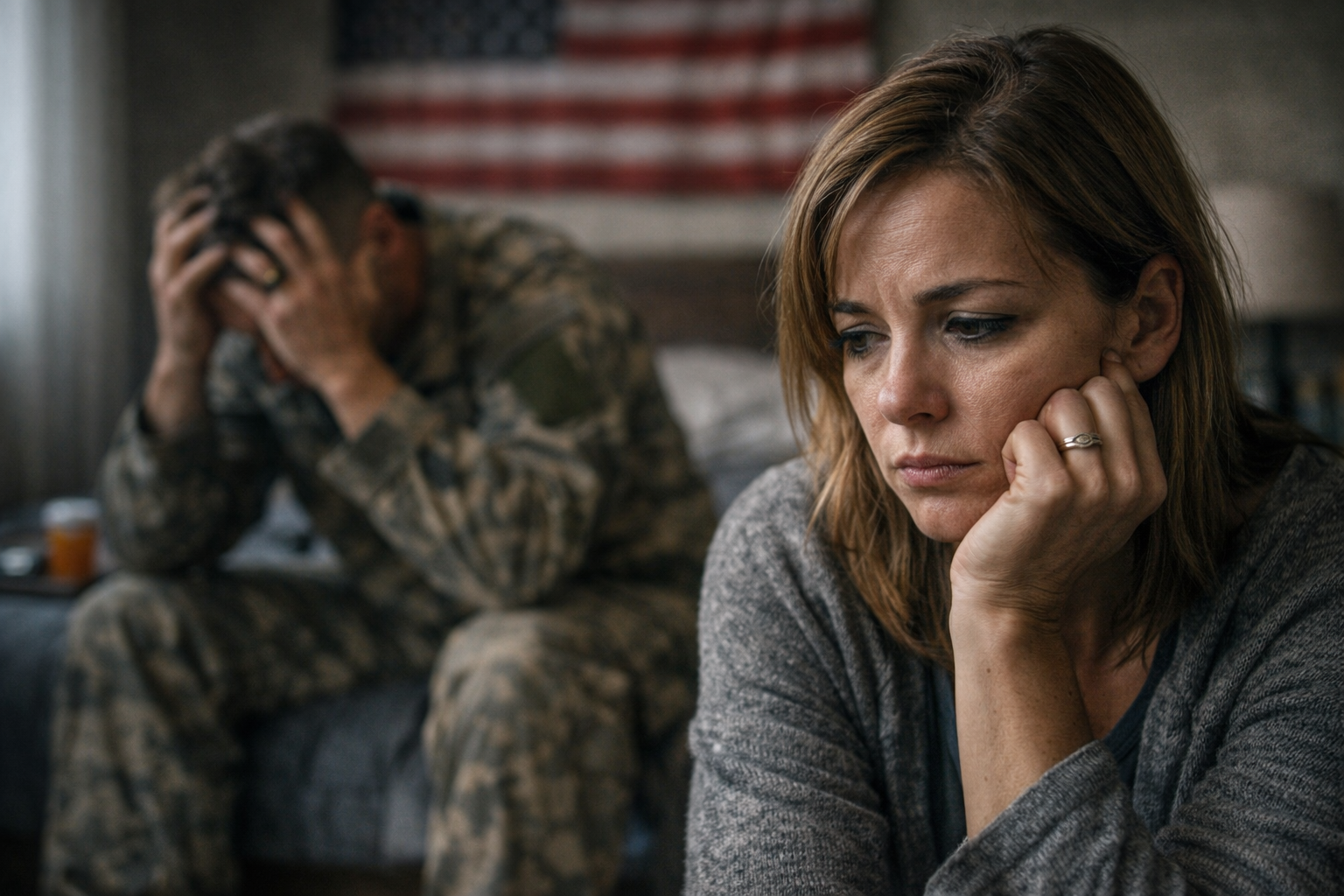
I write this as a wife fighting for her marriage, not as an analyst studying one.
While access to ibogaine is expanding, the support systems required to use it safely are not.
Today, ibogaine stepped closer to legitimacy.
Policy is moving. The tone has shifted—from fringe to medicine-adjacent—and voices like Morgan Luttrell are helping lead that charge. His willingness to speak not only about treatment, but about the suicide rate among veteran spouses, matters.
Because it tells a truth we are only beginning to acknowledge:
Trauma is never contained to one person.
The Narrative Is Incomplete
Ibogaine is being framed as a breakthrough—and it may be.
Observational studies suggest meaningful reductions in opioid withdrawal and craving, and improvements in mood and trauma symptoms in certain populations (Brown & Alper, 2018; Davis et al., 2020). A recent study in special operations veterans reported significant psychological improvements following magnesium-ibogaine treatment (Mithoefer et al., 2024).
But those outcomes did not occur in a vacuum.
They occurred in the presence of:
- medical screening
- cardiac monitoring
- structured environments
- psychological support
- integration care
And that distinction matters.
Because the drug is not the intervention.
The system around it is.
What Ibogaine Actually Does
Ibogaine disrupts entrenched patterns—neurologically and psychologically. It alters reward pathways, reduces withdrawal symptoms, and can catalyze intense introspective experiences (Alper et al., 1999; Brown & Alper, 2018).
It opens the mind under pressure.
That’s the part we call breakthrough.
But it doesn’t open one door.
It opens all of them.
And not everything behind those doors is ready to be handled safely.
The Risks We Quietly Acknowledge—and Publicly Downplay
Ibogaine is not physiologically neutral.
The literature consistently documents:
- cardiac risk, particularly QT prolongation and arrhythmias (Koenig & Hilber, 2015; Litjens & Brunt, 2016)
- neurologic and psychiatric destabilization, including cases of mania and psychosis (Noller et al., 2018)
- and a need for rigorous screening and monitoring protocols
Even in controlled settings, this is not a benign intervention.
And outside of those settings?
The variability increases.
Who We Are Actually Treating
The population at the center of this conversation—combat veterans with addiction and trauma—is not a neutral substrate.
Substance use disorders in this group are strongly associated with:
- PTSD
- depression and anxiety
- traumatic brain injury
- chronic stress exposure
(Hoge et al., 2004; Seal et al., 2011)
And critically:
Mental illness and social isolation are deeply intertwined.
Individuals with substance use disorders are significantly more likely to experience social disconnection, and that disconnection worsens both psychiatric outcomes and relapse risk (Volkow et al., 2016; Hawkley & Cacioppo, 2010).
Layer onto that:
- disrupted trust
- hypervigilance
- identity fracture post-service
And you are no longer treating a single condition.
You are working within a complex human system under strain.
Addiction Lives in the Family System
Addiction does not occur in isolation.
It exists within relationships—and it reshapes them.
Research consistently shows that family dysfunction and relational instability both contribute to and result from substance use disorders (McCrady & Epstein, 2009).
Which means:
Treating the individual without addressing the system they return to is not comprehensive care.
It is partial intervention.
The Invisible Load
This is where the conversation becomes more difficult—and more necessary.
Spouses of veterans often function as:
- stabilizers
- emotional buffers
- interpreters of behavior
- logistical anchors
All while carrying:
- chronic uncertainty
- emotional volatility
- sustained psychological load
Often silently.
I know this list because I live it. I am not describing a population — I am describing my own days. I carry them because I chose this man, and I am still choosing him.
There is a reason emerging conversations around spouse suicide risk are gaining attention.
That risk reflects prolonged exposure to unrelieved complexity—not weakness.
Where Ibogaine Complicates the System
Ibogaine may open the patient.
But opening is not the same as stabilizing.
Post-treatment states can include:
- emotional intensity
- impulsivity
- sleep disruption
- identity destabilization
In some cases, mania or hypomania-like presentations have been observed (Noller et al., 2018).
To the patient, this may feel like clarity.
To the person living beside it?
It can feel like chaos.
And here is the problem:
There is currently no standardized system to support the people absorbing that impact.
Risk Doesn’t Disappear. It Moves.
When a powerful intervention is introduced into an already strained system without adequate support:
The burden does not resolve.
It redistributes.
Often onto the spouse.
The family.
The people already carrying the weight — not as collateral, but as the ones who chose to stay.
Healing Is Not a Single Event
The current narrative suggests:
Drug = breakthrough
But the more accurate equation is:
Drug + structure + integration + relational stability = potential for healing
Remove those variables, and outcomes become unpredictable.
And unpredictability, in this context, is not benign.
If This Is the Future—Build It Properly
If ibogaine is going to move forward—and it likely will—then the conversation has to mature with it.
That means:
1. Medical rigor is non-negotiable
- cardiac screening
- medication reconciliation
- supervised dosing
2. Psychiatric screening matters
- identifying vulnerability to destabilization
- planning for post-treatment support
3. Integration must be structured
- not optional
- not one session
- longitudinal, relationally anchored
4. Family systems must be included
- education for partners
- access to support resources
- acknowledgment of shared risk
Because without this:
We are not treating the system.
We are disrupting it.
Final Thought
I respect the potential of ibogaine.
I respect the veterans who are advocating for it.
And I respect those, like Morgan Luttrell, who are expanding the conversation to include the people living beside that reality.
Because if we want real healing—
it cannot belong to the individual alone.
It has to extend to the system they return to.
Otherwise, we are not witnessing transformation.
We are witnessing something far more fragile—
and asking the people who chose to stay to quietly hold the pieces.
References
- Alper, K. R., et al. (1999). Ibogaine in the treatment of opioid dependence.
- Brown, T. K., & Alper, K. (2018). Treatment of opioid use disorder with ibogaine.
- Davis, A. K., et al. (2020). Psychedelics and substance use outcomes.
- Mithoefer, M. et al. (2024). Magnesium-ibogaine in veterans (observational study).
- Koenig, X., & Hilber, K. (2015). Cardiac effects of ibogaine.
- Litjens, R. P. W., & Brunt, T. M. (2016). Toxicity of ibogaine.
- Noller, G. E., et al. (2018). Ibogaine treatment outcomes and adverse effects.
- Hoge, C. W., et al. (2004). Combat duty and mental health.
- Seal, K. H., et al. (2011). Substance use among veterans.
- Volkow, N. D., et al. (2016). Neurobiology of addiction.
- Hawkley, L. C., & Cacioppo, J. T. (2010). Loneliness and health outcomes.
- McCrady, B. S., & Epstein, E. E. (2009). Family involvement in addiction treatment.
Leave a Reply