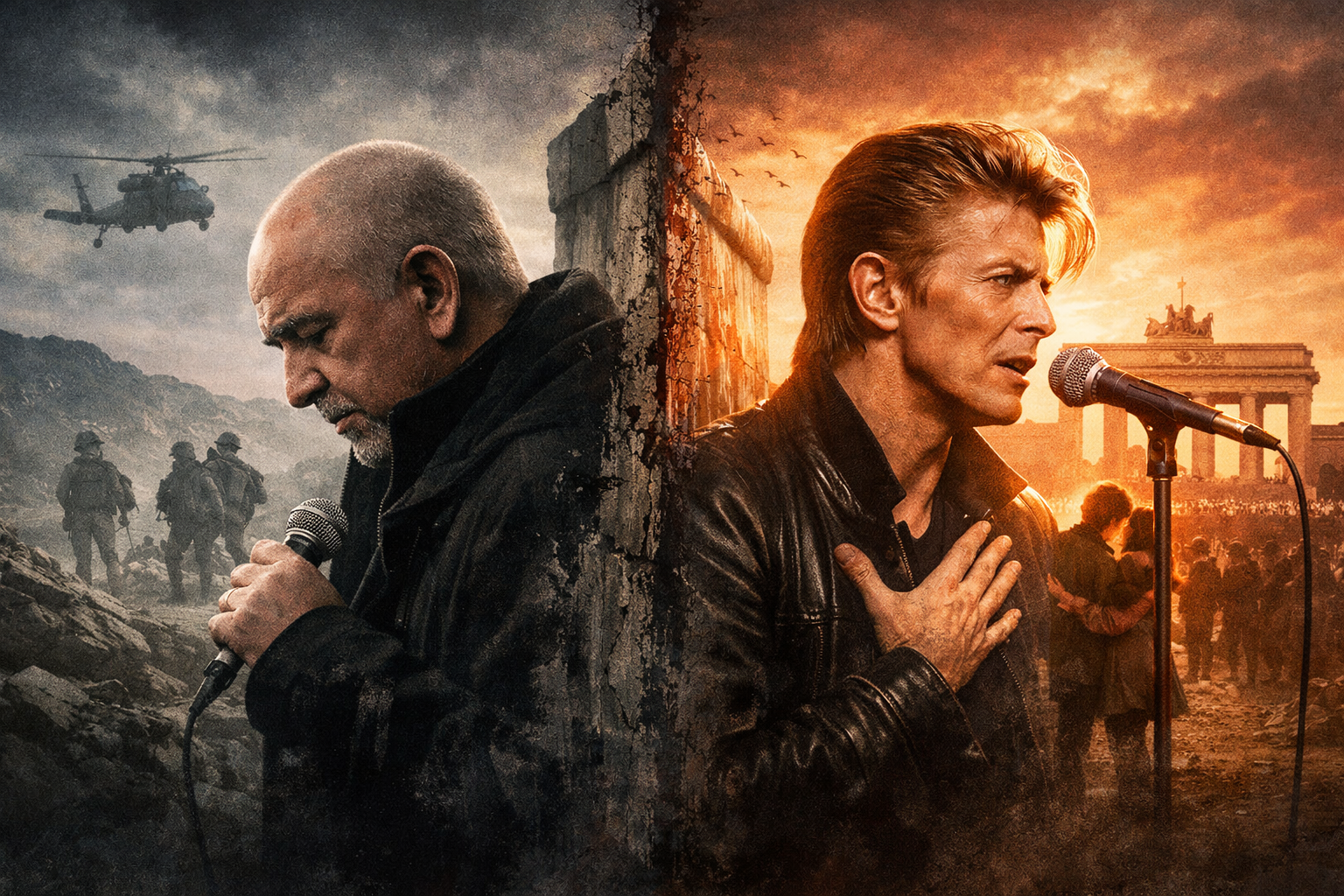
The first time I really heard Heroes wasn’t from David Bowie at all.
It was Heroes, playing in Lone Survivor—and if you’ve seen that film, you know the body is already ahead of the mind. You’re braced. Shoulders up. Breath shallow. There’s no room left for sentimentality.
Gabriel’s version doesn’t try to lift the story. It doesn’t swell into triumph or pretend survival is the same thing as victory. It moves slowly, deliberately, like someone walking through wreckage they already understand too well. The song becomes a witness, not a cheerleader.
And that’s when the line lands:
We can be heroes, just for one day.
Not forever.
Not safely.
Just today.
In that context, it’s not inspirational. It’s devastating. Heroism isn’t framed as glory—it’s framed as exposure. Temporary courage in a permanent world. A single day standing in the open, knowing the cost.
What’s remarkable is how often that same version—Gabriel’s—gets used when a story wants gravity without romance. Early in Stranger Things, when the show is still teaching us how dangerous the world is, they choose his “Heroes.” The slowed-down reckoning. The aftermath tone. Childhood already bruised by forces it doesn’t understand.
Same lyrics.
Different nervous system.
But then something fascinating happens.
In the final episode, Stranger Things switches versions. The needle drops—not on Gabriel—but on Bowie.
And suddenly, the meaning shifts.
Bowie’s “Heroes” is kinetic. It builds. It insists. It reaches upward even while admitting the reach may fail. Where Gabriel sounds like he’s counting the cost, Bowie sounds like he’s daring the universe to interfere.
That contrast isn’t accidental.
Bowie wrote “Heroes” in Berlin, staring at a wall meant to make hope irrational. The song was never naïve—it was defiant. Love as rebellion. Courage as volume. Two people choosing each other for a moment in a world that made no promises.
Gabriel didn’t change the lyrics when he covered it decades later. He just let them age.
His version feels like what happens after the day has passed. After the bravery has been measured and buried. After the story has been told so many times it starts to lose its shine and gain its weight.
Bowie says: We can be heroes.
Gabriel asks: What did it cost?
And when filmmakers choose between them, they’re choosing more than a soundtrack. They’re choosing a philosophy.
Use Gabriel when you want the audience to feel the burden.
Use Bowie when you want them to remember why anyone stood up in the first place.
That’s the strange, quiet power of repurposed music. Songs don’t stay frozen in their original meaning. They accumulate context. They absorb history. They become emotional shorthand for entire eras of fear, bravery, and loss.
A song that once sounded like hope can later sound like mourning.
A song that once felt defiant can later feel sacred.
And maybe that’s why “Heroes” keeps returning when the world feels especially fragile. Because it refuses to lie. It doesn’t promise safety. It doesn’t guarantee survival. It only offers this:
One day can matter.
One act can mean something.
Even if it doesn’t save you.
Especially if it doesn’t.
Leave a Reply